My escape from the concrete and steal that surrounds my Chicago apartment is the park and lakeshore. Both Lincoln Park and Lake Michigan’s shores are located a short walk from my place. I moved to this area of Chicago less than a year ago and ever since have considered myself very fortunate to be able to enjoy nature whenever I want. In minutes, I can be walking through the park or running down the lakeshore path, enjoying that the city’s skyscrapers are a backdrop to the water’s edge. Or that instead of running on a sidewalk alongside traffic, the sounds of bleating horns and revving engines are in the distance instead of immediate.
But then I went to Honduras.
As I said in my previous entry, true vacationing to me is meant for experiencing a life unlike my own. Honduras served that purpose in many aspects of my trip, but none so powerful as visually. The difference in the change of scenery from the varying elevation of Chicago’s skyscrapers as compared to the varying elevation of Honduras’ mountains went a long way to provoke my ideal vacation feeling. It also helped that every place Sara, Kristin and I stayed was surrounded with they type of nature I’d have to travel for days to find anywhere outside Chicago’s limits.

The first place we stayed the
Hotel Canadien - a cozy resort located in Sambo Creek on the north coast. The grounds were lush with palm trees, two outdoor swimming pools, plenty of lounging chairs, and balconies that begged me to stroll and enjoy the Caribbean breeze from every possible vantage point. And should me and my traveling companions grow tired of the hotel’s inviting ambience, just opposite of its wrought iron gate was the Caribbean. The opposite view from the ocean bein the hotel set at the base of lush, green mountains. My typical view in Chicago is of my neighbor’s drapes just across the courtyard.
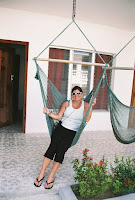
Sara, Kristin and I found our days in Honduras generally started early and ended early. My favorite time at the Hotel Canadien quickly became early in the morning, before breakfast. I soaked in the breeze in one of the two hammocks just outside our room, curled up with a book . Some of our afternoons were spent lounging by the pool and some of our nights were spent dining seaside.
This is not to say the entire country lives this well, by any means. We passed plenty of homes throughout our trip that had no windows, no doors and some times a patchwork of tin for roofs. We drove through

pueblos that, had they been located in the U.S., I would have been scared out of my mind waiting for the sound of gun shots. These places felt much different in Honduras, though. In these tiny villages, we stopped many times and asked directions and always found a helpful soul willing to point us in the right direction - granted sometimes advice was followed by the request for a few lempiras (Honduras’ national currency). But I still never felt scared. Honduras is most definitely not a wealthy country, but even in passing through these small communities there was an undeniable spirit of togetherness and closeness that is lacking in a major way in most major cities - Chicago included.
Our time at the Hotel Canadien last just a few days and then it was off to our second home of the journey. We spent just one night at the
D&D Brewery, but it was enough to make a lasting impression. Sara, Kristin and I made our way

to the middle of the Honduras on Wednesday. We arrived at the D&D, nestled just outside El Lago de Yajoa (Honduras’ largest lake). The D&D is tiny, but it attracts people from all over the world. This fact is understandable given that its charm is immediately apparent.
We stepped down the stone entryway to find a small swimming pool and cabin, where we checked in. Adjacent to it were three covered areas with chairs and tables that served as the gathering spots for whoever was staying in the D&D’s cabins, bunks or camping on its grounds. We spent the majority of our time at the brewery eating and playing cards at these tables. On Thursday morning, I

walked through the property snapping photos of the plant life, which again is located nowhere near my surroundings in Chicago.
The nature there was apparent everywhere. I felt as if I couldn’t escape it, but I also didn’t want to. It was intoxicating to sit, feel the breeze, let the sun warm my face and become wrapped up in the small sounds of life carry on around me. In Chicago, my apartment is the place where I find solace. It is sitting on my couch at the end of the day that calms me from the previous eight, frantic hours I spent at work. But that feeling

pales in comparison to Honduras. There I didn’t want to be indoors. The places we stayed were wonderful, but they couldn’t match the tranquility I found being in nature. I preferred the shade of trees to a roof over my head.
Our final resting place on our Honduran adventure was El Rancho Sante Fe - the orphanage where Sara works located about 45 minutes outside the capital of Tegucigalpa. To sum up, it looks and feels like a giant summer camp.
Sara and the other volunteers stay in their own building, separate from the orphans on the ranch. It’s a square building enclosing a giant courtyard with a giant tree. The building is flanked by two person rooms that the volunteers

share. The kids on the ranch stay in much larger buildings. Sara’s girl, a rag tag bunch of sassy, giggly 11 and 12-year-olds, sleep about 40 to a room on bunks three-beds tall. Each kid has one locker that holds their entire wealth of worldly possessions. I felt greedy thinking of how sometimes I feel cramped in my larger-than-average, three-room studio. The girls also share a courtyard and living/game room. It appears, though, they spend a lot of time outdoors. If they’re not doing one of their many chores, like cleaning or tending to their gardens, they’re running and playing and being kids the best way they know how.
As was typical in Honduras, we got slightly better treatment on the ranch than most Hondurans enjoy in their daily life. We stayed in a newly constructed building with its own kitchen and rooms with toilets that work the way we Americans know them to work. However, we didn’t have hot water, which unfortunately is the norm for Sara.
El Rancho Santa Fe is set on several acres of land. Small buildings sprout up in its gently sloping terrain, but for the most part its open and peaceful. What the homes and shelters of Honduras may lack in modern amenities, they certainly make up for in their the neighboring scenery. Even though we stayed in different locations with different surroundings in Honduras, each one held its own natural beauty. It was something I hadn’t even realized I missed until

I was there. The lakeshore and my neighboring park in Chicago pale in comparison to the raw, untouched beauty of Honduras. It’s found everywhere - in the distant jutting mountains on the north coast, in the neighboring streams and ponds of the Lago and in giant trees that spring forth from of the ranch’s land.
On our first day, as we drove up to the coast, it appeared to me that the country and the people had so little. As we passed dilapidated homes, four-person families sharing one bike simultaneously, children in tattered clothes selling honey on the side of the road, I could help but wonder what people did to pass the time. I guessed most of the country’s inhabitants had no TV, no neighboring malls, no movie theaters and not any first class (or second class) dining. Was this it? Did they tend their gardens, wash their clothes and sell whatever little they had to spare? Did they then end their days with sparse meals, go to bed in their door-less homes and be bothered by the buzzing of mosquitoes and flies all night? I couldn’t imagine a life so slow – a life without the endless pursuits of the American ideal. But by the end of the trip I had a much different view. I saw their lives were full. Full of a slower pace of life – of actually living their lives and enjoying their lives, lazily dreaming away the days surrounded by untouched paradise.
 A special thanks to my tech support (AKA Mike) for bringing photos to this entry.
 After a weekend of roughing it in a tent, I found myself Monday night lounging on my parents couch channel surfing. Seeing as their TV is an LCD flat screen and mine has tin foil as an antenna, it was enjoyable to sit and flip mindlessly.